
FAQs from OWI Customers, Answered by Our Technical Team
- Industry News
- PEAK, BlueDEF
- June 11, 2026
Get real answers from OWI’s technical experts on DEF shelf life, wiper blades, adapters, date codes, and more straight from the people behind the products.
In his role as director of technical services for Old World Industries (OWI), Tom Cholke has fielded a huge volume of customer queries over the years. About 14,000 technical questions came in during 2025, keeping Tom and his close-knit team both busy and engaged.
"We take pride in the work we do," Tom says. "We're live people to talk to. You're not going to be getting a voicemail. There's no AI dead end. We make sure we resolve issues with customers, and we don't leave them hanging."
That commitment to personalized service with a human touch puts OWI in a class of its own. "Our competitors, from what I've heard, don't necessarily offer that level of service," Tom shares. "That's what sets us apart. If a question comes in, we will do what we need to do to get it answered."
About 80% of the questions that find their way to Tom's team come from everyday drivers seeking info on OWI product details. Common examples include:
- What is the Shelf Life of My Diesel Exhaust Fluid?
- How Can I Find Out When My OWI Product Was Made?
- My BlueDEF Isn't Actually Blue. Does That Indicate a Problem?
- Which Adapter Do I Need For My New Wiper Blades?
- How Do I Install My New Wiper Blades?
Tom and his team also conduct investigations when mechanics give customers the runaround by blaming OWI products for vehicle problems. This is where Tom and his team’s experience and technical know-how shine, as he delivers accurate, dependable insights backed by data and documentation.
Here are answers to some of the most common questions Tom and his team get from customers:
What is the Shelf Life of My Diesel Exhaust Fluid?
If you store your diesel exhaust fluid (DEF) in its original container and avoid exposing it to direct sunlight, it will stay good for a very long time. "DEF has a typical shelf life of about two years, if it's stored in a climate-controlled environment," Tom says.
Tom also recommends some best practices to extend your DEF's shelf life. "The product is temperature-sensitive, to the point where its shelf life decreases when the temperature increases," Tom explains. For optimal storage, try to keep your DEF within a temperature range of about 15 to 77 degrees Fahrenheit (-9 to 25 degrees Celsius).
While two years is the official shelf life, PEAK BlueDEF can stay good for much longer. "When the International Standards Organization first came out with this product, they had to put a shelf life on it just to make sure that people weren't carrying it on their shelf forever," Tom says.
If handled and stored properly, BlueDEF can last longer than two years. "I've never seen diesel exhaust fluid product go bad over any period of time, however, if in doubt, use a refractometer to measure the urea concentration and confirm it is between the accepted range of 30.8% to 34.2%” Tom says.
How Can I Find Out When My OWI Product Was Made?
Of course, you'll need to know when your DEF was made to figure out whether it's still within its official two-year shelf life window. All PEAK BlueDEF containers include a date code that specifies where and when the product was manufactured. However, deciphering that code can be a little confusing.
"We've recently tried to standardize our date codes," Tom says. Here's how the standardized date code system works:
- The first string of digits in the date code specify the terminal where the product was made.
- Following that, you will find the year the product was manufactured. In some cases, the year displayed may be plus or minus one year from the actual date of manufacture, as some OWI production facilities use different internal tracking systems.
- The next numbers show the day of the year the product was produced: the Julian date (the number of days that have passed in the year, beginning with January 1).
- The final string of numbers specify the batch number, which tells you the specific production run the fluid came from.
Here's a real-life example to help you make sense of OWI's date coding details:
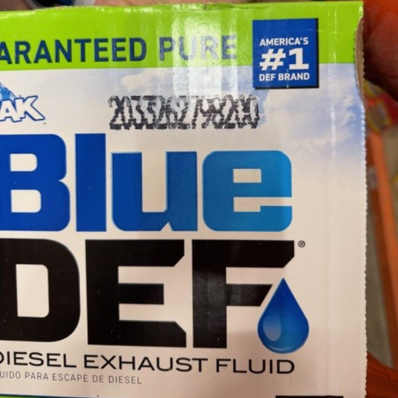
2033262798200
2033 = the bottling plant
26 = current year +1, so 2026 = 2025 + 1
279 = How many days into the year 279 days in the year is 10/6/2025
8200 = The batch number
This DEF was made on Tuesday October 6th of 2025.
My BlueDEF Isn't Actually Blue. Does That Indicate a Problem?
OWI's PEAK BlueDEF is the number one diesel exhaust fluid brand in the United States. However, the fluid itself is clear, not blue, and that can lead to some confusion.
As Tom explains, the BlueDEF name is about branding, not the color of the product. "BlueDEF refers to a 'blue sky' initiative of keeping the environment cleaner," he says. "It's a clear fluid made with just water and urea."
For more information, review this resource on DEF purity and how DEF works to reduce emissions from diesel-powered vehicles.
Which Adapter Do I Need For My New Wiper Blades?
"We often get questions regarding which adapter is needed or not needed for the wiper blade a customer purchased for their vehicle," Tom says. "Wiper blades need different adapters because of the different arm types on different vehicles."
The answer to this one is pretty straightforward: "The adapters come with the wiper blade," Tom explains. "The product is ready to go as the customer purchases it." People sometimes simply don't realize the adapters they need are included with the product.
How Do I Install My New Wiper Blades?
Customers sometimes encounter trouble with DIY wiper blade installations. "Fortunately, PEAK has instructional videos, and people can actually view those to help them understand," Tom says. You can find installation instructions for all kinds of PEAK wiper blades in OWI's DIY Hub.
However, as Tom notes, that solution doesn't work for everyone. "In some cases, you get folks who don't want to look up the video tutorial, or don't have that capability," Tom says.
In these situations, Tom’s team is happy to talk customers through the installation process. If you're having trouble installing your PEAK wiper blades and the video tutorials aren't helping, feel free to reach out for personalized support.
How OWI Performs Technical Investigations
"We do get claims coming in on diesel exhaust fluid," Tom shares. Occasionally, folks will use our Diesel Exhaust Fluid product and shortly thereafter, a check engine light will come on. They'll go to the dealership, and the dealership will kind of blame the fluid because it's the easiest thing to do, and they don't want to fight with the customer. So, they just drain it, put in fresh fluid, charge them for it, and blame us."
This can lead to customers seeking compensation from OWI, even though OWI's DEF may not actually have been the problem at all. "When those things come up, they find their way to myself and my team," Tom says. "I have my team do some data gathering, and I review that data to make sure that our product was not at fault."
Tom's investigation process involves lab tests and detailed technical analyses of fluid samples. This usually allows Tom to suggest a few possibilities of what went wrong.
"Sometimes there's a known issue," Tom explains. "Sometimes the vehicle computer needs to be re-flashed. Sometimes there's an NOx sensor that went bad. Sometimes we get the fluid sample back and see that it has hard water components in it. This indicates that someone contaminated the fluid with tap water."
Tom carefully documents his findings and issues a customized claim letter explaining the results of his investigation. "If there's a problem with our product, we own up to it and take care of it," he says. "If not, we provide a ton of information showing that the product we sold was not the cause of their issue."
Learn More About the Technical Team Standing By to Answer Any Questions You May Have About OWI Products
The FAQs featured here only scratch the surface of the incredible work Tom and his team do every day to help customers make the most of their OWI products. To learn more about Tom's background and his passion for what he does, review our profile of OWI's technical team and the care they bring to every question that comes in, no matter how simple or complex it may be.