
How To Prevent Urea Deposit Buildup When Using DEF
- Industry News
- PEAK, BlueDEF
- October 30, 2026
Learn how to prevent urea DEF fluid deposit buildup, reduce SCR system failures, avoid costly downtime & keep your diesel fleet running efficiently. Click now.

Diesel exhaust fluid (DEF) is essential to modern fleet operations. Heavy-duty trucks can't meet increasingly tight federal emissions standards without it. Yet, at the same time, DEF can also create some tricky maintenance challenges. These include urea buildup, which can occur in injectors, sensors, and selective catalytic reduction (SCR) system components.
Urea buildup can lead to a whole host of potentially costly problems, with unplanned downtime being a common result. In a worst-case scenario, your drivers could experience sudden engine problems, find themselves with a truck that won't start, or risk expensive damage to sensitive systems and components.
In this post, we'll take a deep dive into urea buildup to explore:
- What is urea in DEF?
- How urea buildup happens
- The costly risks of urea deposit buildup
- How to prevent urea buildup from forming
If you'd like to review some DEF essentials before digging in, you can review our ultimate guide to DEF for all the background info you'll need.
What Is Urea In DEF?
Diesel exhaust fluid is made up almost entirely of deionized water (67.5%) and urea (32.5%). Some premium formulations, like PEAKⓇ BlueDEF Platinum, also use trace amounts of proprietary additives to enhance the fluid's performance.
Urea plays a critical role in DEF chemistry. Once DEF gets injected into a vehicle's hot exhaust stream, it interacts with the harmful nitrogen oxides (NOx) in exhaust gases that pass through the SCR system on their way out the tailpipe.
As Old World Industries (OWI) product engineer Evan Ferguson explains, "The water evaporates, the urea breaks down into ammonia, and that ammonia reacts with the NOx gas at the SCR catalyst to form water and nitrogen, which then leaves through the exhaust stream." Water vapor and nitrogen are essentially harmless, in fact, nitrogen makes up %78 of the atmosphere.
While DEF chemistry works like magic to eliminate hazardous nitrogen oxides, the process isn't always perfect. Under certain operating conditions, some of the urea doesn't fully break down or react from the heat in the exhaust stream as expected. This can lead to urea buildup and DEF crystallization.
How Urea Deposit Buildup Happens
In Episode 1 of OWI's DEFinitive Insights series, product manager Scott Bredenberg identified the two main ways that urea deposit buildup forms in heavy-duty diesel vehicles. "Buildup frequently results from prolonged vehicle operation at lower ambient temperatures, caused by things like idling and stop-and-go driving,” he says. "It could also potentially be [caused by] a system leak or a partially clogged DEF injector."
More specifically, the inefficient decomposition of urea occurs when DEF is injected into the exhaust stream in temperatures below 484°F (250°C). "When we're below 484°F, the water evaporation becomes prolonged," Ferguson explains. "At this stage, urea is able to start to crystallize on certain parts of the aftertreatment system. The urea is then able to polymerize with some of its breakdown products to form larger and larger polymers that are no longer water soluble."
Put simply, urea can start to settle on exhaust system components when interior conditions aren't hot enough to fully break it down into ammonia. This can lead to DEF crystal buildup in the SCR system, potentially causing performance issues, fault codes, and costly repairs.
"There are known conditions for driving that can exacerbate the low temperature of the exhaust gas, specifically driving with low loads or frequent stop-and-gos," Ferguson continues. "This is definitely a frequent problem that can be encountered through normal driving patterns."
From there, continuing to operate the vehicle in low ambient temperature conditions can aggravate existing urea buildup. So, once urea deposit buildup has started to form, it can get bigger with each driving cycle and become harder to remove.

The Costly Risks of Urea Deposit Buildup
Urea and DEF crystal buildup create two main types of problems: compliance risks and mechanical risks.
"The problem with these deposits is that they can start to reduce the surface area available for reactions on your catalyst," Ferguson says. As this situation progresses, the vehicle's SCR system may no longer be able to remove enough NOx from the exhaust stream to meet federal compliance guidelines. If that occurs, you could be left dealing with:
- Failed emissions inspections
- Regulatory enforcement actions
- Costly fines of up to $45,268 per noncompliant vehicle
Urea buildup can also increase back pressure in your SCR and aftertreatment systems, which can reduce both engine power and fuel efficiency. As fuel economy diminishes, your operating costs rise. If the issue affects multiple vehicles or your entire fleet, those costs rise at scale.
The mechanical damage that can result from large, long-term urea deposit buildup has the potential to be even more costly. Three key examples include:
- SCR system damage: Severe deposits can permanently damage a vehicle's SCR catalyst system, and a full replacement may become the only viable option. According to Heavy Duty Journal, SCR replacements can easily cost $10,000 or more per vehicle.
- Engine derating and unplanned downtime: As urea buildup causes SCR system issues, vehicles may respond by progressively losing engine power (derating) or triggering fault codes. If this occurs during a duty cycle, unplanned downtime will result which could cost you $800 to $1,500 per day or more.
- Increased maintenance and repair costs: Urea buildup can take a long time — and a lot of work — to remove. When you factor in lost vehicle uptime and the high cost of replacement parts on top of technician labor, you're looking at a seriously disadvantageous outcome.
There's good news, though: You can avoid urea deposit buildup with the right maintenance practices, vehicle operation habits, and automotive technologies.
How to Prevent Urea Buildup From Forming
There are three specific ways you can stop urea buildup before it causes problems:
Prevent Component Wear and DEF Contamination
Proactive maintenance and safe DEF handling practices can both go a long way toward preventing urea buildup and the problems it can cause. Follow these guidelines:
- Only use high-purity DEF that meets ISO 22241 specifications. This will reduce risks, which can cause premature wear to the DEF injector and prevent SCR performance losses.
- Replace your DEF filter according to manufacturer-recommended DEF system service intervals. Avoid delaying maintenance and immediately address any fault codes that occur.
- Observe proper DEF handling and storage guidelines, and ensure your DEF dispensing equipment is manufactured to high standards and kept clean.
- Have a mechanic remove and inspect your DEF injectors regularly for signs of wear, leakage, or partial clogging that can disrupt DEF delivery.
Use Smart Vehicle Operation Habits
Next, look at operational habits that can help prevent urea deposits from forming as the result of low operating temperatures and SCR system performance losses:
- Minimize unnecessary idling and avoid stop-and-go driving whenever possible.
- Avoid extended low-load vehicle operations, since they can prevent vehicle exhaust temperatures from reaching the critical 484°F/250°C threshold.
- Train your drivers to respond immediately to SCR and DEF system fault codes and warning lights so you can address minor issues before they become a major problem.
Even small changes in driver behavior can have a big impact on the long-term health of your SCR systems.
Choose a Better DEF
One of the best ways to prevent urea buildup is by using a higher-quality diesel exhaust fluid. "There are a couple different deposit prevention technologies available on the market that focus on improving water evaporation after the DEF is injected and therefore allowing the proper urea decomposition to take place," Ferguson advises. "These chemistries are effectively able to help prevent deposit buildup."
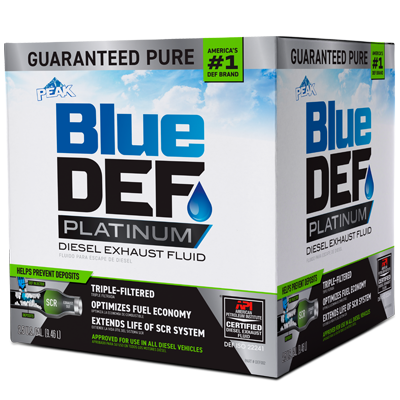
PEAKⓇ BlueDEF Platinum is a great example. This advanced formulation has proprietary additives — manufactured in full compliance with ISO 22241 guidelines — that prevent urea buildup when used regularly. "It allows you to maintain optimum fuel economy by not creating additional back pressure," Ferguson notes. "It also extends the life of your components and helps to prevent downtime and costly repairs."
For the best value, source your BlueDEF Platinum in bulk: OWI offers a 330-gallon tote format that delivers maximum bang for your fleet management buck while providing effective protection against urea buildup.